Your phone has no signal. The generator doesn't run until evening. There is no Wi-Fi, no news feed, no notifications. There is only the sound of the forest, the smell of woodsmoke from cook fires, and the soft murmur of a community that has lived this way — deliberately, peacefully — for over 18 generations. Welcome to Waerebo, the village in the clouds of Flores, and one of the most humbling travel experiences in all of Southeast Asia.
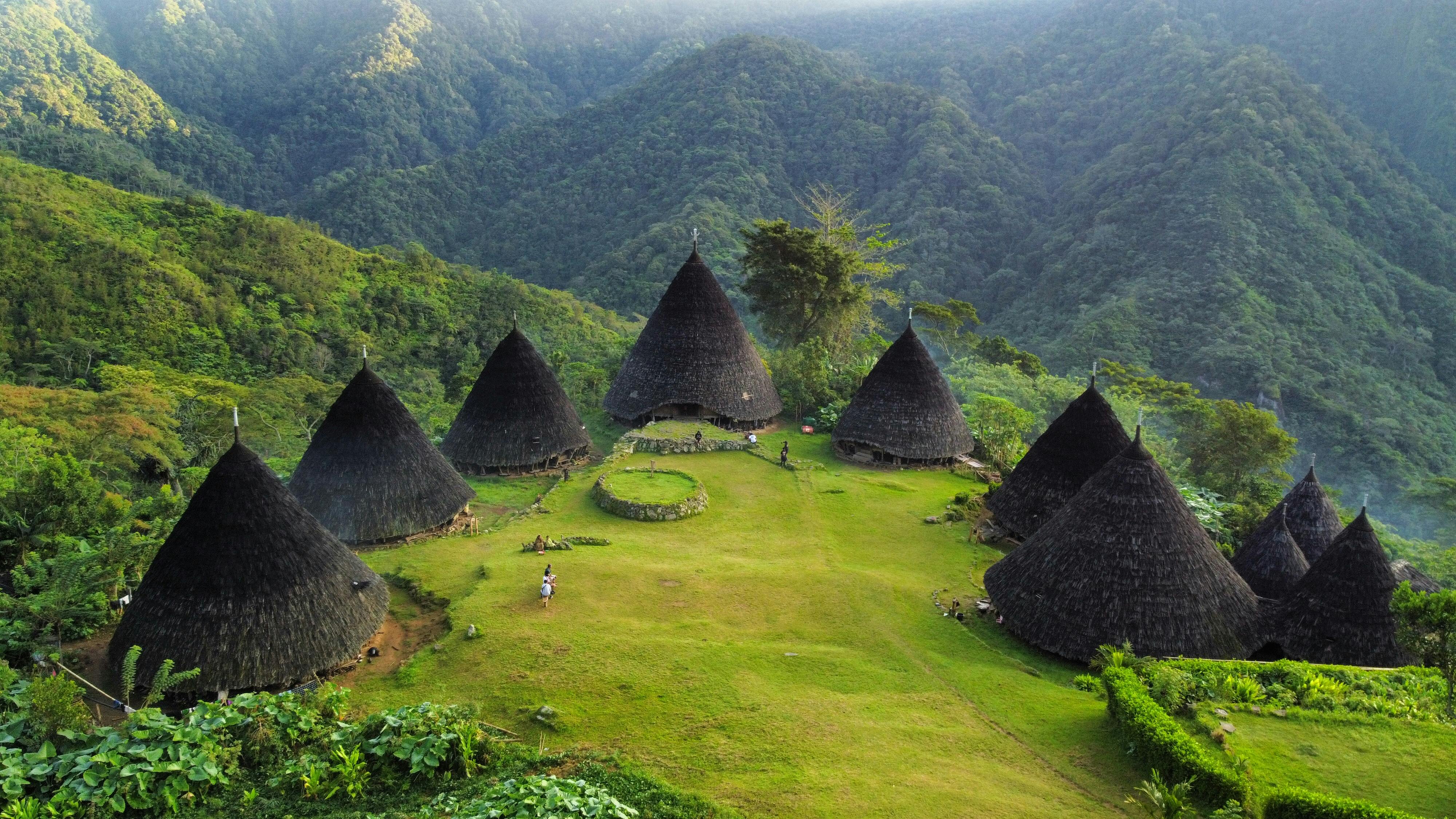
Perched at 1,200 meters above sea level in the mountains of West Manggarai Regency, Flores, Waerebo is not a village you stumble upon. You earn it — with a 2 to 3-hour forest trek that climbs steadily through mist, bamboo groves, and the calls of unseen birds. And when the fog clears and you see those seven cone-shaped roofs rising from a mountain clearing, the exhaustion disappears completely.
I've traveled to 40 countries. Waerebo is the only place where I genuinely did not want to leave. Not because of the scenery — though it's extraordinary — but because of what it does to your mind.
— Thomas K., traveler from Amsterdam, Special Trip with Basa Basi Trip, February 2025
The Mbaru Niang: Architecture That Defies Time
The defining feature of Waerebo is its seven Mbaru Niang — traditional conical houses that rise dramatically against the mountain sky. These structures are not just homes; they are a living expression of the Manggarai people's cosmology, social structure, and relationship with the natural world.
Each Mbaru Niang is built over five floors, with each level serving a specific communal function. The ground floor is for daily living and family life. The second floor stores food and supplies. The third is for seeds — the community's future harvests. The fourth and fifth floors hold ritual objects and offerings, connecting the physical world to the spiritual one above. The entire structure is built without nails, using only rattan bindings and traditional joinery that has survived earthquakes, storms, and centuries.
In 2012, Waerebo received the UNESCO Asia-Pacific Heritage Award for Cultural Heritage Conservation — one of the most prestigious recognitions in architectural preservation. The award acknowledged not just the buildings themselves, but the community's extraordinary commitment to maintaining their living traditions in a rapidly modernizing world.
Getting to Waerebo from Labuan Bajo
The journey from Labuan Bajo to Waerebo is itself an experience worth documenting. The route winds approximately 140 kilometers through the dramatic mountainous interior of Flores — a 4 to 5-hour drive through small villages, rice terraces, and mountain passes that reveal Flores in its rawest, most beautiful form.
The drive ends at the village of Denge, the starting point for the trek to Waerebo. From Denge, the trail climbs through primary montane forest for approximately 7–9 kilometers depending on route, with a total ascent of around 600 meters. Most travelers of average fitness complete the trek in 2 to 3 hours at a comfortable pace.
Wear closed-toe shoes with grip — the trail is muddy after rain and steep in sections. Bring at least 1.5 liters of water per person for the ascent. A light daypack only — your overnight bag will be transported separately. Start trekking before 9 AM to avoid afternoon mist and heat. And take your time: rushing the trail means missing the forest.
Overnight in the Village: What to Expect
Visitors to Waerebo are accommodated inside the Mbaru Niang themselves — sleeping on the ground floor alongside community members, on traditional woven mats, under wooden-beamed ceilings blackened by decades of cook-fire smoke. This is not glamping. This is genuine cultural immersion, and it is extraordinary.
The community prepares meals using ingredients grown in their surrounding gardens: rice, vegetables, sweet potato, and often fresh fish from nearby rivers. Before dinner, visitors are welcomed with a traditional Caci welcome ceremony — offerings, prayers, and the symbolic sharing of palm wine. This is not a performance for tourists; it is a genuine ritual of hospitality that the community has practiced for generations.
An Evening Without Screens
After dinner, as the generator powers down and the village settles into darkness lit only by oil lamps and stars, something rare happens: conversation. With your travel companions, with community members through your guide's translation, or simply with yourself. Travelers consistently report that the evenings at Waerebo — without the constant pull of phones and notifications — are the most memorable part of the experience.
At dawn, the mist rolls through the mountain valleys and catches the first light in ways that no photograph fully captures. If you're awake early enough, you'll see the village women already at work, carrying baskets, tending fires, moving through their morning routines in a rhythm that feels ancient and completely unhurried.
The Responsible Tourism Commitment
Waerebo has thoughtfully managed tourism to protect both the community and the culture. There is a strict visitor limit per night — typically around 40–50 guests maximum — to ensure the village is never overwhelmed. All entrance fees go directly to the community fund for Mbaru Niang maintenance and community programs.
When visiting with Basa Basi Trip, your guide will prepare you thoroughly on cultural etiquette: how to greet elders respectfully, what areas are ceremonially restricted, how to photograph without intruding, and why certain rituals are not appropriate for photos at all. Responsible travel to Waerebo means the community can continue welcoming visitors for generations to come.
We arrived exhausted from the trek. The village elder greeted us with palm wine and a quiet smile. By the time we left the next morning, something had shifted. I can't quite explain what — but I think about Waerebo more than any other place I've been.
— Lena M., traveler from Singapore, January 2025
Waerebo as Part of Your Flores–Labuan Bajo Trip
Waerebo is best experienced as a 2-day 1-night extension added to a Komodo sailing trip. The typical itinerary: arrive in Labuan Bajo, complete your sailing trip, then spend a day and night at Waerebo before flying home. This gives you the best of both worlds — Komodo's marine paradise and Flores' mountain culture — in one cohesive journey.
Basa Basi Trip's Waerebo Special Trip includes round-trip transport from Labuan Bajo, a local trek guide, all meals, and overnight accommodation in the Mbaru Niang. Group sizes are kept small to ensure a meaningful, personal experience — not a crowded day-tour feel.
Quick Facts: Waerebo Village
- Location: West Manggarai Regency, Flores, East Nusa Tenggara (NTT)
- Altitude: 1,200 meters above sea level
- Distance from Labuan Bajo: ~140 km (4–5 hrs by road)
- Trek from Denge: 7–9 km, 2–3 hours, moderate difficulty
- Accommodation: Inside traditional Mbaru Niang (ground floor)
- UNESCO recognition: Asia-Pacific Heritage Award 2012
- Best time to visit: April–October (drier trails); year-round access