There is a moment — the exact second you slip below the surface and a shadow the size of a dining table glides silently beneath you — when everything else disappears. No phone notifications. No to-do list. Just you, the current, and a creature that has existed for 75 million years. This is Manta Point, Komodo National Park, and it is unlike anything else on Earth.
Located between Komodo Island and Rinca Island in the heart of Komodo National Park, Labuan Bajo, Manta Point is consistently ranked among the world's top five snorkeling and diving sites for manta ray encounters. Every year, thousands of travelers fly to Labuan Bajo specifically for this experience — and very few leave disappointed.
I've snorkeled in Bali, Thailand, and the Maldives. Nothing — nothing — compares to floating alongside a manta ray at Manta Point. It's completely humbling.
— Jamie R., traveler from London, joined 3D2N package, March 2025
What Exactly is Manta Point?
Manta Point is a natural underwater cleaning station — a specific reef area where manta rays congregate regularly to be cleaned by smaller fish called cleaner wrasse. These tiny fish remove parasites from the mantas' skin and gills, essentially offering a spa service that keeps the gentle giants healthy. Because manta rays return to cleaning stations habitually, sightings at Manta Point are remarkably consistent year-round.
The waters here are fed by strong nutrient-rich currents from the Indian Ocean, which also attract plankton — the manta ray's primary food source. This combination of feeding ground and cleaning station makes Manta Point one of the most reliable manta ray encounters in the world, not just in Indonesia.
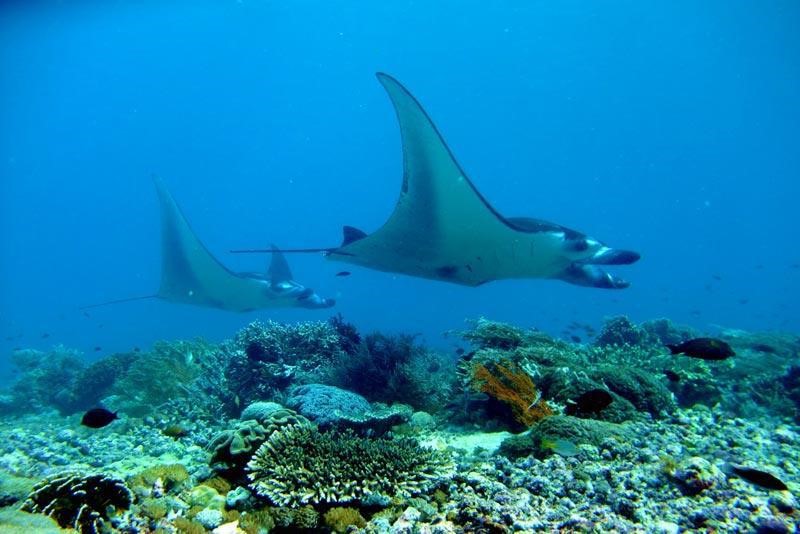
The Manta Rays of Komodo: What You'll See
Two species of manta rays inhabit Komodo's waters: the Reef Manta Ray (Mobula alfredi) and the much larger Oceanic Manta Ray (Mobula birostris). The reef mantas are the most commonly seen at Manta Point, with wingspans typically ranging from 2 to 4 meters. The oceanic variety can reach up to 7 meters — wider than many cars are long.
Manta rays are completely harmless to humans. They have no stinger, no teeth capable of biting, and no aggressive behavior. What they do have is curiosity — mantas are known to approach snorkelers and divers, sometimes circling them in what researchers describe as investigative behavior. If you stay calm and still, a manta may pass within arm's reach.
Manta rays are present year-round at Manta Point, but sightings peak between November and April (Green Season) when water temperatures are slightly warmer and plankton blooms are richer. During peak dry season (July–August), you may encounter stronger currents — still excellent for experienced swimmers, but trickier for beginners.
How to Get to Manta Point from Labuan Bajo
Manta Point is accessible only by boat from Labuan Bajo harbor — there is no land route. The journey takes approximately 2.5 to 3.5 hours depending on sea conditions and your vessel type. This is why Manta Point is almost always included as a stop on multi-day sailing trips rather than a standalone day trip — though one-day excursions are possible.
With Basa Basi Trip, Manta Point is a standard stop on all packages: One Day Trip, 2D1N, and 3D2N. Our guides know the best window times to arrive — typically mid-morning when the tide and current align for optimal visibility and the most manta activity at the cleaning station.
Snorkeling vs. Diving at Manta Point
You do not need to be a certified diver to experience Manta Point — snorkeling here is genuinely world-class. Manta rays frequently cruise at the surface level or within 3–5 meters of depth, perfectly visible to any snorkeler wearing basic gear. In fact, many experienced divers report that their most memorable manta encounters happened while snorkeling, simply because you can move more freely at the surface.
That said, diving does offer the advantage of stability — you can hover at the reef's edge near the cleaning station and wait for the mantas to orbit you. If you're a certified diver, ask your guide about dive conditions on the day of your visit.
What to Bring for the Best Experience
- Snorkeling mask that fits properly — leaky masks are miserable in current. Test it before entering the water.
- Fins — not essential, but they allow you to hold position against the current without exhausting yourself.
- Rash guard or wetsuit top — the sun at sea level is intense, and you can burn through the water without realizing it.
- Underwater camera or GoPro — smartphone footage works too, but a waterproof case is non-negotiable.
- No touching, no chasing — this is both ethical and practical. Mantas that feel harassed will dive deep and disappear.
Komodo National Park regulations strictly prohibit touching, riding, or chasing manta rays. Sunscreen chemicals can also harm them — use reef-safe, mineral-based sunscreen only. Our guides will brief you on responsible snorkeling before entering the water. These rules exist to protect a population that is classified as Vulnerable on the IUCN Red List.
What If You Don't See Manta Rays?
It's a fair question — and honest guides will tell you that while sightings are common, they are never guaranteed. Manta rays are wild animals, and ocean conditions change daily. In our experience operating hundreds of trips, manta ray encounters at Manta Point occur on roughly 85–90% of visits during peak season and around 70% outside peak season.
On the rare days when mantas don't appear at the main cleaning station, experienced guides like ours know secondary spots nearby — including feeding corridors where mantas surface to feed on plankton concentrations. The ocean is never a dead end when you're with someone who knows it well.
I was nervous I wouldn't see them. But within five minutes of entering the water, three mantas flew right underneath me. I cried inside my mask. I'm not ashamed to admit it.
— Sari W., Bandung, 2D1N package, January 2025
Including Manta Point in Your Labuan Bajo Trip
Manta Point is approximately 60 kilometers from Labuan Bajo harbor, placing it deeper into Komodo National Park than most day-trip boats comfortably reach. This is why we strongly recommend at least a 2-day 1-night sailing package if Manta Point is a priority for you — it allows the boat to position overnight and reach Manta Point at the optimal morning window, rather than rushing against the clock on a day trip.
All Basa Basi Trip packages include Manta Point as a standard stop. Our crew carries full snorkeling equipment, a GoPro for documentation, and our guides are experienced in reading manta ray behavior to maximize your time in the water with these magnificent animals.
Quick Facts: Manta Point, Komodo
- Location: Between Komodo Island and Rinca Island, Komodo National Park, NTT
- Best months: November–April for peak sightings; year-round for reliable encounters
- Species: Reef Manta Ray (2–4m) and Oceanic Manta Ray (up to 7m)
- Depth for snorkeling: 0–5 meters — no diving certification required
- Distance from Labuan Bajo: approx. 60 km by boat (2.5–3.5 hrs)
- Entrance fee: Included in Komodo National Park ticket (managed by your tour operator)